
Best Non Greasy Daily Face Creams for Every Skin Type
Best Non Greasy Daily Face Creams for Every Skin Type
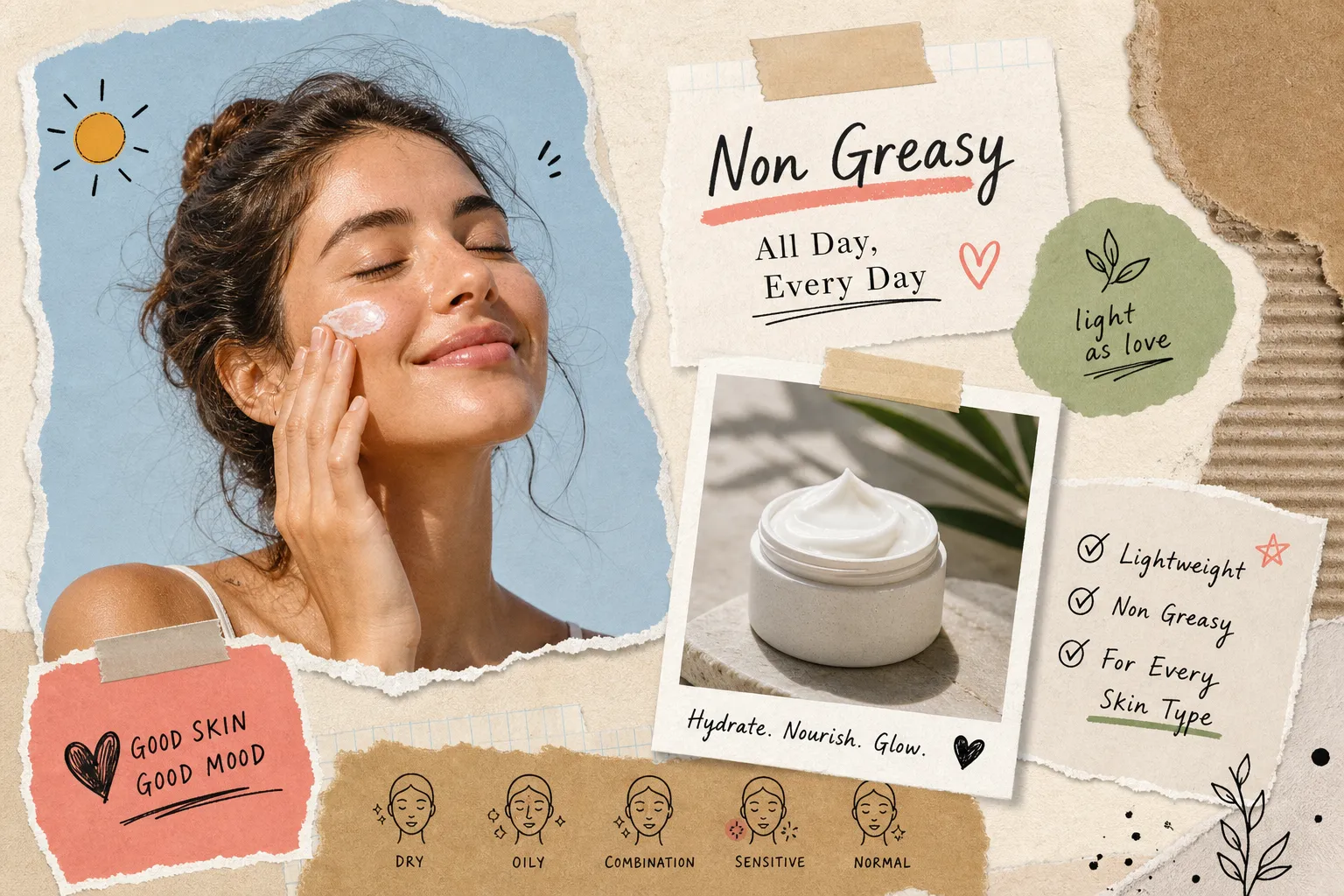
A good non-greasy daily face cream should not announce itself on your face. If you apply your daily moisturizer in the morning and your skin looks like it's been oiled down an hour later, the formula is not working for you. It's working against you.
This is one reason so many people skip moisturizer altogether. They've tried enough creams that promised lightweight hydration and delivered a shiny, suffocating film, and they've decided their skin just doesn't need it. That conclusion is wrong, but it's understandable. At Hermelis Cosmetics, we've built around a single conviction: real hydration and a weightless finish are not mutually exclusive. They're a formulation choice.
What follows is a clear-eyed breakdown of why so many traditional face creams feel greasy, what separates a genuinely non-greasy daily face cream from the marketing version, and how to read an ingredient label before you spend a dollar. By the end, you'll know exactly what to look for and what to skip.
Why so many traditional face creams end up feeling greasy
The answer is not complicated, but most brands don't explain it. Many conventional face creams are built on emulsions with a high oil content, particularly water-in-oil formulas or oil-in-water blends with a heavy occlusive load. When those oils are long-chain, dense, or present in high concentrations, they don't absorb into the skin. They sit on top of it. That slick, reflective finish you associate with moisturizing is not hydration. It's residue.
Traditional formulations leaned on petrolatum, paraffin, and rich plant butters as standard emollients and stabilizers. These ingredients work well for healing, dry winter skin, or overnight repair, they're optimized for occlusion and barrier recovery rather than daytime wear. Most were not designed to be the backbone of a formula worn under makeup or SPF. The context matters, but many brands haven't updated their formulas to reflect how people actually use moisturizer now.
Occlusive ingredients add another layer to this problem. Petrolatum, beeswax, and heavy mineral compounds create a physical barrier on skin that locks in moisture. That's genuinely useful in a nighttime or therapeutic context. In a daytime formula, when occlusives are overused, they trap water and oil together at the surface and limit normal skin breathability. That's the greasy feeling that persists for hours. It's not your skin type. It's a formulation imbalance.
What actually creates a non-greasy finish in a face cream
A water-based or gel-formula moisturizer is built primarily around water rather than oil. It uses humectants and lightweight emollients to carry hydration into the skin, leaving minimal residue at the surface after absorption. These formulas dry down quickly and leave a smooth, sometimes slightly dewy finish without a visible sheen.
Water creams sit in a useful middle ground. They're a hybrid between a gel and a traditional cream: faster absorbing than a cream, more hydrating than a straight gel, and light enough to work across most skin types without either sitting on the surface or feeling insufficient. The texture is what sets them apart from both ends of the spectrum.
Some oil-free moisturizers go a step further and include mild film-formers or oil-absorbing ingredients like zinc compounds or silica that manage shine through the day. These are common in formulas marketed specifically for oily skin. A gel that simply has a light texture is different from one formulated for active oil control. That distinction matters, especially for combination skin types where only certain zones need that management.
How to read an ingredient label before you buy a non-greasy daily face cream
The ingredient list tells you more than any marketing claim on the front of the package. The first five to seven ingredients make up the majority of the formula. Everything else is present at lower concentrations. If you learn to read from the top down, you can identify a lightweight moisturizer in under a minute.
Ingredients that signal a lightweight, non-greasy formula
The ingredients that signal a non-greasy formula are the humectants and lightweight emollients. Sodium hyaluronate pulls water into the skin without sitting on top of it, partly because its smaller molecular size allows it to act in the upper skin layers rather than forming a surface film. Glycerin works similarly, though formulas that rely heavily on glycerin at concentrations above around eight to ten percent can feel tacky rather than clean, most formulators keep it in the three to five percent range for a cleaner finish. Caprylic/capric triglyceride, squalane, and panthenol are lightweight emollients that improve slip without leaving visible oil at the surface. Niacinamide supports the skin barrier while also helping manage excess sebum. When you see these ingredients near the top of a list, you're looking at a formula built for a weightless finish.
Red-flag ingredients for daytime wear
The red-flag ingredients are petrolatum, paraffin, heavier waxes, and rich butters like shea or mango butter when they appear in the first five to seven positions. This is not an argument against those ingredients in all contexts, they have real value in therapeutic and overnight formulas. It's about placement. A product with petrolatum listed tenth is very different from one where it appears second. Worth noting: these same ingredients are excellent in a repair balm or overnight mask, where occlusion is actually the goal. Ingredient list order is the most honest formulation transparency tool any brand has, and most people don't use it.
Which texture works best for your skin type
For oily and combination skin, a hydrating face gel or oil-free cream with non-comedogenic ingredients is typically the strongest choice. Skipping moisturizer often makes oiliness worse, skin that is dehydrated produces more sebum to compensate. A gel moisturizer absorbs fastest, gives the cleanest finish, and is a solid option for wearing under makeup or in humid climates. The non-comedogenic label is a reasonable signal, though keep in mind that in the U.S., there's no FDA-standardized test brands must pass to use that claim. Reading the ingredient list is more reliable than trusting the label alone.
For dry and sensitive skin, lightweight does not have to mean insufficient. A water cream that layers humectants at meaningful concentrations alongside a skin-compatible emollient base can deliver deep, lasting hydration without the greasy aftermath. The key distinction is whether the formula actually delivers hydration or just sits at the surface creating the sensation of it. Sensitive skin types should prioritize fragrance-free formulas above everything else, since fragrance is one of the most common sources of irritation in skincare, even in products marketed as gentle.
The general texture hierarchy works like this: gel moisturizers absorb fastest and give the strongest shine control; oil-free creams offer a bit more cushion with a comparable finish; lightweight lotions sit between them, more hydrating than a straight gel but less rich than a traditional cream. Matching texture to your skin's oil behavior is more reliable than matching by skin type label alone.
Hermelis Luminour Water Cream: where this thinking is built in
The Hermelis Luminour Water Cream was formulated to close the gap between real hydration and a weightless finish. It's a water-based formula designed to absorb quickly, leave no oily residue, and support lasting moisture throughout the day. The texture sits between a gel and a light cream, which means it's intended to work across skin types without feeling too thin for dry skin or too heavy for combination skin.
The ingredient decisions are intentional. Sodium hyaluronate draws moisture into the upper skin layers rather than forming a surface film. Rosa canina contributes brightening and skin-evening properties with a lightweight oil profile. White tea extract provides antioxidant support against environmental stressors without adding heaviness. Together, these ingredients are formulated to offer what an oil-heavy traditional cream typically cannot: hydration focused on improving skin condition rather than simply coating the surface.
This is what clean ingredient transparency looks like in practice. Not a list of things the formula doesn't contain, but a clear account of what each ingredient is there to do. If you've cycled through enough moisturizers that left you looking greasy or feeling congested, the Luminour Water Cream is worth examining label by label before you write off daily moisturizing altogether.
How to apply a non-greasy daily face cream without pilling or breakouts
Pilling is frequently caused by application mistakes, though formulation factors can play a role too. It most commonly happens when a moisturizer is applied over a product that hasn't fully dried, or when too much product is used at once. The fix is straightforward: apply your face cream on clean, slightly damp skin, use a pea-sized amount, and wait at least a minute before applying SPF or makeup. Fast-absorbing gel formulas typically set more quickly, but they can drag against incompatible textures if layered too fast.
Too much product is the most common mistake people make with lightweight formulas. A non-greasy daily face cream applied in a thick layer behaves like a heavier cream. The skin can only absorb so much at once, and the excess sits on the surface. Pressing the formula into the skin with fingertips rather than dragging it across the face speeds absorption and reduces the chance of residue. For oily skin types, applying a thin second layer only over genuinely dry areas prevents the T-zone from looking shiny by midday.
Pilling under foundation is often a compatibility issue between film-forming ingredients in your moisturizer and those in your primer or foundation. If you're experiencing this, the answer is usually to let the moisturizer sit longer before applying makeup, use less product, or look for a moisturizer formulated specifically for under-makeup wear with minimal film-forming polymers.
The right formula is the one that disappears
Choosing a non-greasy daily face cream is not complicated once you know what you're reading on the ingredient label and what your skin actually needs. The greasy residue most people have accepted as the price of moisturizing is a formulation problem, not a permanent condition of having skin.
Start with water-based formulas built on humectants. Match texture to your skin's oil behavior. Read the ingredient list from the top down rather than trusting front-of-pack claims. If you want a formula where that thinking has already been done for you, the Hermelis Luminour Water Cream is a natural starting point.
Your skin does not have to feel like anything to be deeply hydrated. The best moisturizer is the one you forget you're wearing.
Frequently asked questions about non-greasy daily face creams
What makes a face cream non-greasy?
A non-greasy daily face cream is typically water-based, built on humectants like sodium hyaluronate and glycerin rather than heavy occlusives. The formula absorbs into the skin rather than sitting on the surface, leaving little to no visible residue after drydown.
Can a non-greasy face cream still hydrate dry skin?
Yes. A well-formulated water cream layers humectants at effective concentrations alongside lightweight emollients to deliver genuine hydration without a heavy finish. Lightweight does not mean under-hydrating, it means the formula is optimized for absorption rather than surface coating.
Is a gel moisturizer the same as a non-greasy face cream?
Not always. A gel moisturizer is typically the lightest texture option and the fastest to absorb. A non-greasy daily face cream can include water creams and oil-free lotions that offer more cushion than a straight gel while maintaining a weightless finish. The right texture depends on your skin's hydration needs and oil behavior.
How do I know if a face cream is non-comedogenic?
In the U.S., there's no FDA-standardized test that defines non-comedogenic, so the label alone isn't enough. The most reliable approach is reading the ingredient list: avoid formulas where petrolatum, heavy waxes, or pore-clogging butters appear in the first several positions.
Why does my lightweight moisturizer still pill under makeup?
Pilling is most often an application issue. Applying moisturizer over products that haven't dried, or using too much product, are the most frequent causes. Formulation incompatibility between film-forming ingredients in your moisturizer and your primer or foundation can also contribute. Waiting at least a minute after applying your face cream before layering makeup typically resolves it.
About the Author
This article was prepared by Neha A Katkar, a creative professional and business strategist with knowledge, competence in skincare.
(Written and published by Neha A Katkar)